.webp)
The Lauterbrunnen waterfalls from Wengen: Staubbachfall and Trümmelbach
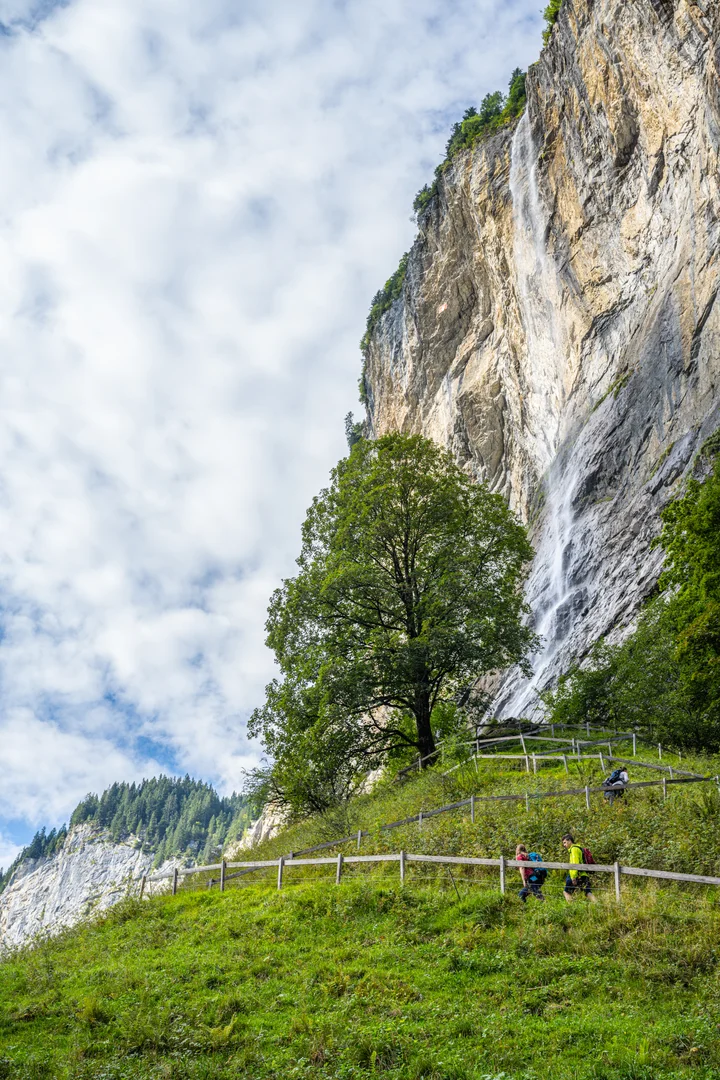
The Staubbachfall is the reason most people stop in the middle of Lauterbrunnen village and look straight up. Water leaves the cliff at 297 metres and mostly turns to spray before it lands, which is how it earned its name and its reputation as the highest free-falling waterfall in Switzerland. From Wengen you are twelve minutes and one train ride above it. That proximity shapes the whole day. You can drop down before the coaches arrive, walk the Staubbach and the Trümmelbach at a sensible pace, and be back on your terrace by late afternoon. This guide covers the logistics of doing exactly that.
Getting down from Wengen to the valley floor
Wengen is car-free. The village is reachable from Lauterbrunnen only by public transport, on foot or by bicycle, so the Wengernalpbahn is your route in both directions. The cogwheel train takes roughly twelve minutes down to Lauterbrunnen and runs about twice an hour through the day, which means you can leave after breakfast without checking a timetable too closely.
Lauterbrunnen station puts you at the north end of the village, and everything in this guide starts from there. Two notes worth planning around. First, the descent is the easy part and the return climb is equally simple, so there is no need to rush the last train. Second, buy your valley travel before you set off if you are using a pass, because the ticket window in Lauterbrunnen builds a queue in July and August.
The Staubbachfall, ten minutes from Lauterbrunnen station
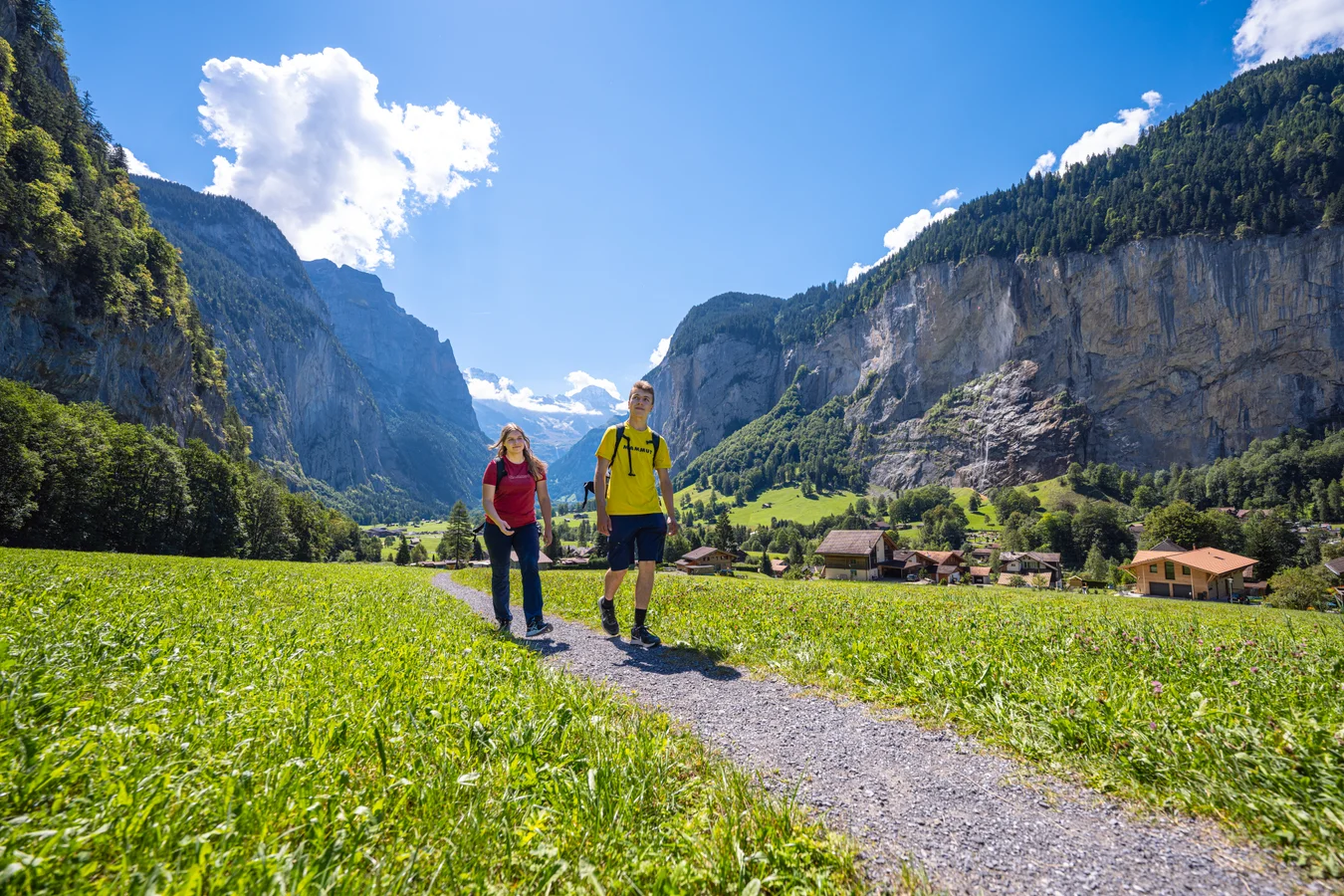
Turn left out of the station and walk south through the village on the main street. The fall is visible the whole way and the walk to the meadow below it takes about ten to fifteen minutes on flat tarmac and gravel. There is no admission charge, no ticket office and no opening hours at the base. You can stand under the drifting spray for as long as you like, which in a light wind reaches a surprising distance across the field.
The height is the detail people get wrong. Lauterbrunnen Tourism gives 297 metres, and Jungfrau Railways rounds it to 300 metres in its own material. Either way it is one continuous free fall, not a cascade, and the volume varies enormously with the season.
The gallery path behind and above the falls
Behind the meadow, a stairway climbs into the rock and a short tunnel brings you out on a secured gallery set into the cliff, part way up and slightly behind the water. This is the part most people remember afterwards. Switzerland Tourism lists the gallery as walkable from May to October, so it closes for the winter and can also shut in bad weather or when rockfall or ice makes it unsafe.
Allow about thirty to forty minutes for the climb, the gallery and the way back down. The steps are steep and wet in places, the handrails are continuous, and trainers with grip are enough. You will get damp. That is the point. Our page on the Staubbach Fall has the walking detail if you want to check it before you leave the hotel.
When the Staubbachfall looks its best
Lauterbrunnen Tourism notes the fall is at its most powerful in spring and early summer, when snowmelt is feeding it. By late August it can thin considerably in a dry spell, and on a windy day much of it disperses before reaching the ground. That drifting spray is the behaviour that made Goethe write about it, though early summer gives you the heavier curtain of water.
The Trümmelbachfälle, ten glacier falls inside the mountain
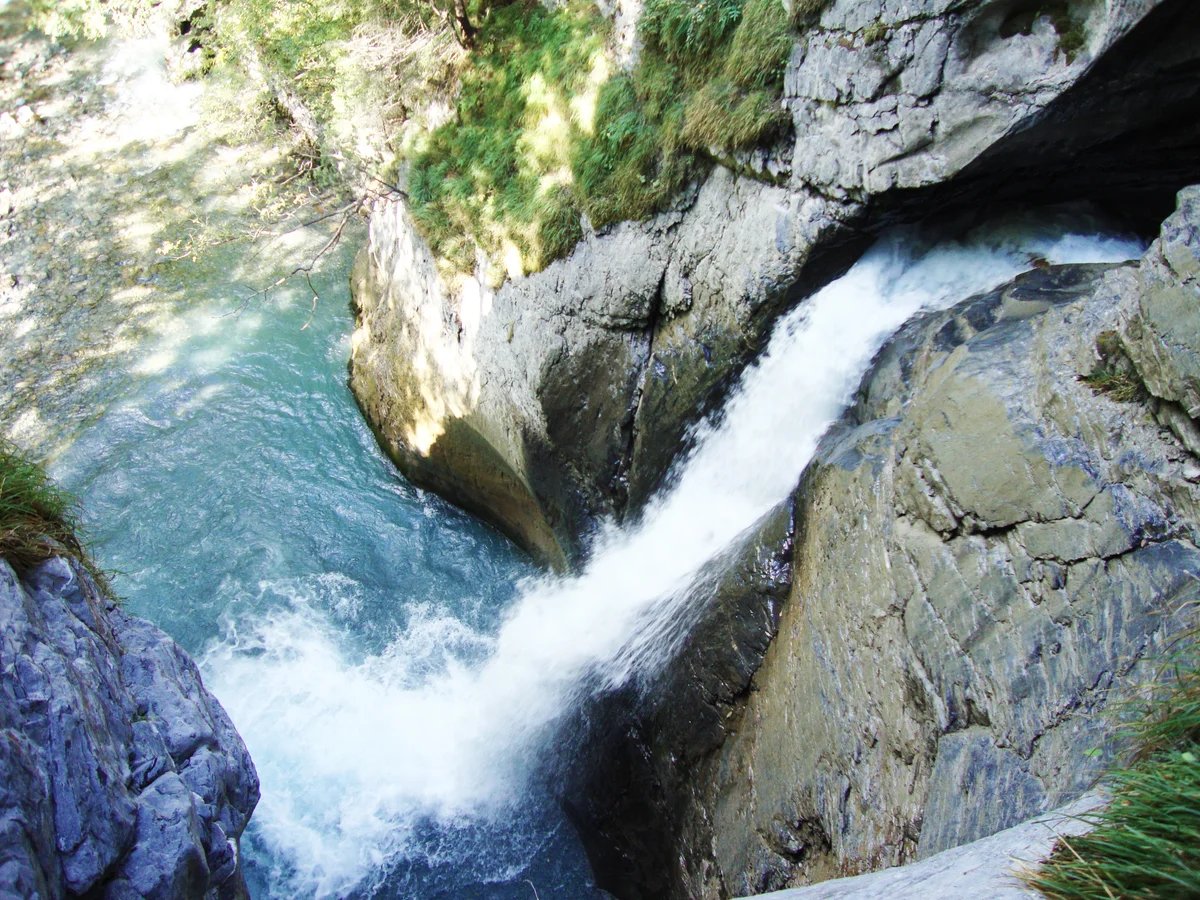
The Trümmelbach is the opposite experience and the stronger one in poor weather. It drains the Eiger, the Mönch and the Jungfrau, and it has cut ten waterfalls into the inside of the mountain rather than down its face. Galleries, tunnels and a tunnel lift take you up through the gorge to see them. The water carries up to 20,000 litres per second at peak melt and shifts around 20,000 tonnes of debris a year, and you feel all of it in the noise and the cold air.
Getting there from Lauterbrunnen
Take PostAuto line 141 from Lauterbrunnen station towards Stechelberg and get off at the Trümmelbachfälle stop, a few stops down the valley. Buses are timed against the trains, so a Wengen departure connects reasonably well. Walking is the alternative if you want the valley floor path past the meadows and the smaller falls, and it takes roughly forty-five minutes each way on level ground.
Season, price and timing
The falls open daily from the beginning of April to the beginning of November, from 09.00 to 17.00, extending to 08.30 to 18.00 in July and August. Exact opening and closing dates move with the weather, so call ahead at the very start or end of the season. Adult admission is CHF 18.00 and children aged 6 to 15 pay CHF 8.00. Children under 4 and dogs are not admitted, for safety reasons inside the gorge.
Allow about an hour inside, more if you stop at every viewing platform. Take a light waterproof layer and shoes with grip, because the galleries are permanently wet and noticeably colder than the valley floor. Full detail sits on our Trümmelbach Falls page.
Which falls suit rain and which suit sun
Pick by forecast and you will not waste a day.
Rain favours the Trümmelbach. You are inside the mountain, the light is low and even, the water is running hard and the crowds thin out. It also tends to be at its most dramatic after heavy rain or during a warm spell of glacier melt.
Sun favours the Staubbachfall. The spray needs light to do anything interesting, and the rainbow at the base of the fall only appears when the sun is on it. A grey day flattens the whole cliff.
Best light for photographs
The Staubbachfall faces roughly east, so it takes direct sun in the morning and falls into cliff shadow by early afternoon. Arrive between about 09.00 and 11.00 for light on the water and a chance of a rainbow in the spray. Late afternoon gives you soft light on the valley floor and the village, with the fall itself in shade, which suits wider compositions more than close-ups.
Inside the Trümmelbach, light is limited and mixed. Brace against a railing rather than reaching for a higher ISO, and expect lens spray. A cloth in your pocket is worth more than any filter here.
What else to add on the same day
Jungfrau Railways markets Lauterbrunnen as the Valley of 72 Waterfalls, and the figure is a local count rather than a formally audited one, so treat it as the valley's own description. Several of those are easy to fold in.
The Mürrenbachfall, near Stechelberg at the head of the valley, is the tallest in Switzerland and sits close to the same bus line. The valley floor path between Lauterbrunnen and Stechelberg strings a dozen of the smaller falls together in about two hours of flat walking. If you would rather stack the waterfalls into a broader itinerary, our wider round of day trips from Wengen sets them alongside Jungfraujoch and the Schilthorn.
A realistic full day looks like this: down on the 09.00 train, Staubbachfall and the gallery until about 10.30, bus to the Trümmelbach for 11.00, back in Lauterbrunnen for a late lunch, and up to Wengen by mid-afternoon. That leaves the best part of the day still ahead of you.
Staying above the valley is what keeps this trip unhurried, and that is the case for basing yourself at Victoria Lauberhorn, Wengen, a Faern Collection Hotel. You are twelve minutes from the Staubbachfall, first down in the morning, and back to a quiet terrace above the cliffs when the day trippers are still queueing for the train.
Prices, opening times and season dates in this article were correct when it was written and are not updated continuously. Please check the current details with the operator or on the official website before you travel.