
Lauterbrunnen Valley
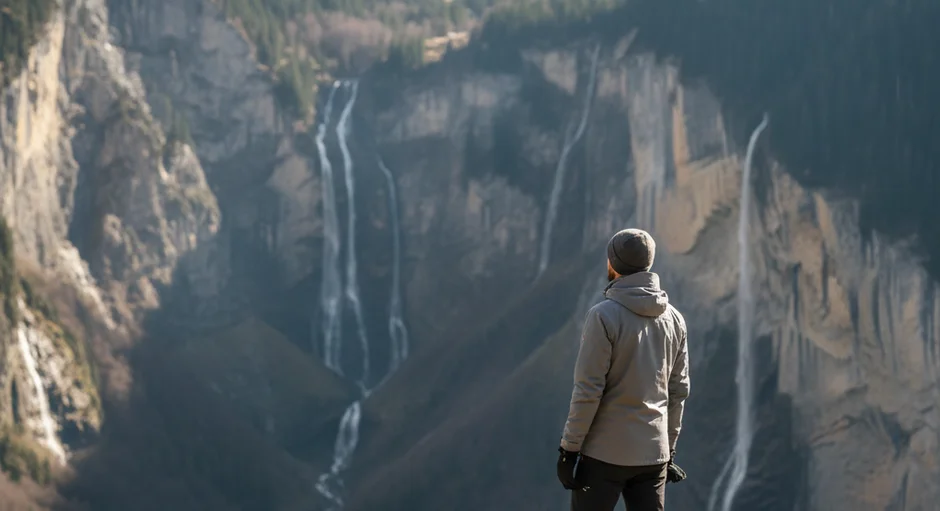
The name says it all. Lauterbrunnen translates roughly to "many springs," and the valley delivers on that promise with 72 waterfalls tumbling from limestone cliffs that rise up to 400 metres on either side. This is one of the deepest glacially carved valleys in the Alps: a perfect U-shape, barely a kilometre wide at the floor, where the sound of falling water reverberates off sheer rock walls and follows you wherever you walk.
Wengen sits 480 metres above this valley on a south-facing sun terrace at 1,274 m. The perspective matters. Most visitors arrive in Lauterbrunnen village and look up. Staying in Wengen, you look down first, surveying the full sweep of the valley, its ribbon waterfalls catching the light like threads of silver against dark rock. Then you descend, by cogwheel train or on foot, and experience it all again at close range.
At a glance
The Lauterbrunnen Valley stretches roughly five kilometres from Lauterbrunnen village (795 m) south to the hamlet of Stechelberg, where the cliffs narrow and the road ends. The valley floor is flat, green, and remarkably gentle given the vertical drama surrounding it. A well-maintained path runs the full length, suitable for wheelchairs and pushchairs on the main sections.
Access from Wengen could not be simpler: the cogwheel train covers the 480-metre descent in eleven minutes. Trains run approximately every thirty minutes throughout the day. Sit on the left side heading down for the best views into the valley.
Both Wengen and the car-free village of Mürren, perched on the opposite cliff, are reached from the valley floor. This makes Lauterbrunnen a natural hub for excursions in every direction: south towards Stechelberg and the Schilthorn cable car, north to Kleine Scheidegg and the jungfraujoch trip, or across to Mürren and Gimmelwald.
What makes the Lauterbrunnen Valley special
-
A literary landscape: Lord Byron visited Staubbach Falls in 1816 and wrote his dramatic poem "Manfred" in response to the valley's scale. Goethe had come decades earlier, in 1779. J.R.R. Tolkien is said to have drawn inspiration from the Lauterbrunnen Valley for Rivendell in The Lord of the Rings. Stand on the valley floor, look up at the cliffs and the cascading water, and the connection to Tolkien's hidden elven refuge feels less like tourism marketing and more like simple observation.
-
The acoustic dimension: The valley functions as a natural amphitheatre. Water roars, echoes, and whispers depending on where you stand and what season it is. Near Trümmelbach, the thunder of glacial meltwater inside the mountain is so powerful you feel it in your chest. At Staubbach, the sound is softer: a persistent hiss as 297 metres of free-falling water disperses into mist before reaching the ground.
-
Year-round character: The valley transforms with the seasons rather than shutting down. Spring snowmelt (April and May) makes the waterfalls ferocious. Summer fills the meadows with wildflowers and the paths with long daylight hours. Autumn brings golden larches and empty trails. Winter drapes the cliffs in ice, and Staubbach Falls often freezes into an enormous blue-white column.
Staubbach Falls
The first waterfall you notice on arriving in Lauterbrunnen is Staubbach Falls, plunging 297 metres from the cliff edge directly above the village. It is one of the highest free-falling waterfalls in Europe, though "falling" is not quite the right word: the water drops so far that wind scatters it into a fine mist long before it reaches the ground. Goethe described it in his poem "Gesang der Geister über den Wassern" (Song of the Spirits over the Waters), and on a breezy day, when the cascade drifts and sways across the rock face, you understand why he gave it a spiritual quality.
A short footpath climbs from the village to a point behind the falls. The walk takes roughly ten minutes each way and is moderately steep near the top. Bring a waterproof layer; you will feel the spray. The best time for photography is late afternoon, when the sun enters the valley from the west and can produce rainbows in the mist. The path may close in winter when ice makes conditions hazardous; check locally before setting out.
Trümmelbach Falls
Two kilometres south of Lauterbrunnen village, the valley's most powerful waterfalls are entirely hidden inside the mountain. Trümmelbach Falls consist of ten glacier-fed cascades that have carved spiralling channels through the rock. They drain the enormous ice walls of the Eiger, Mönch, and Jungfrau, carrying an estimated 20,000 litres of water per second during peak melt. These are the only subterranean waterfalls in Europe accessible to the public.
A tunnel lift carries visitors into the mountain, and from there you follow walkways, galleries, and stairways carved into the rock. The experience is visceral: the roar of water surging through narrow gorges, the cool damp air, the swirling plumes of mist. It is educational as well as dramatic; interpretive displays explain the geological processes at work.
Trümmelbach is open year-round, though the most spectacular time to visit is May and June when snowmelt is at its peak. The interior tunnels are damp, cool, and occasionally slippery, so wear sturdy shoes and bring a light jacket even on warm days. A PostBus runs from Lauterbrunnen village and stops near the entrance.
Walking the valley floor
The flat path between Lauterbrunnen and Stechelberg is the quietest and most meditative way to experience the valley. Five kilometres, no significant elevation change, and a different waterfall visible every few hundred metres. The Weisse Lütschine river runs alongside, milky with glacial rock flour, and you pass through open meadow with picnic spots beside the water.
This walk is ideal for families with young children. Plan roughly two hours at a relaxed pace with stops. You can take the PostBus back from Stechelberg, or continue to the cable car station for the ride up to Mürren and the Schilthorn.